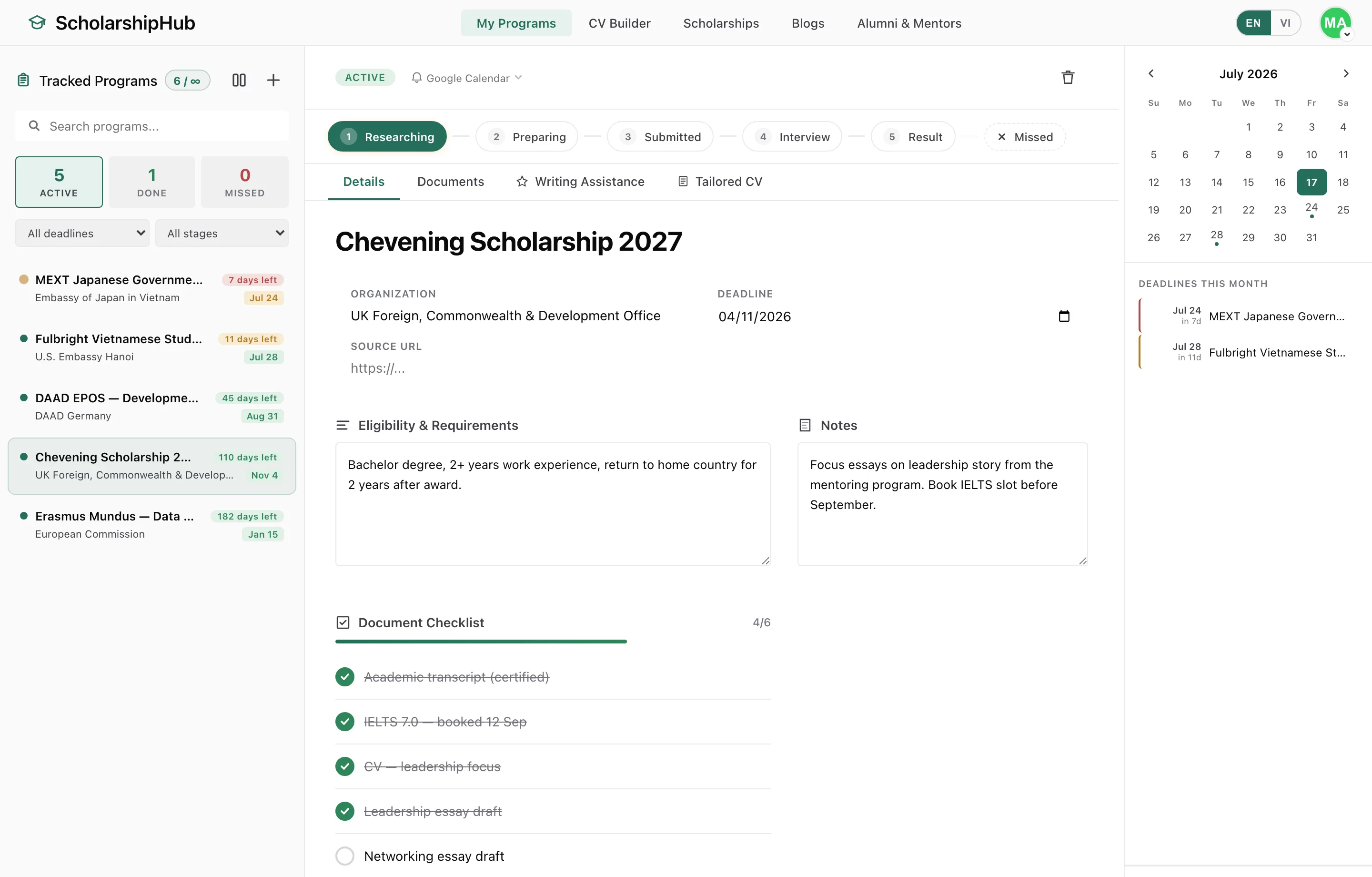
ScholarshipHub did not become a real product when I deployed the first version. It became real when people I did not know began using it in ways I had not planned.
A 90-day Google Analytics snapshot captured on 27 July 2026 showed 837 active users. The product admin recorded 64 registrations, and the business had reached its first paying customer. These are early signals, not a victory lap. They are useful because they changed the questions I was asking.
Before usage, every idea looks equally important
The original problem was straightforward: scholarship applicants were managing deadlines, eligibility rules, essays, references, documents, and different CV versions across disconnected tools. I wanted one operating system that could connect discovery to application progress.
When no one is using a product, it is easy to spend time on features that are intellectually satisfying but operationally unimportant. A founder can mistake the size of an idea for the size of a customer need.
Usage creates friction, and friction creates priorities. Search behavior reveals whether opportunity discovery is clear. Incomplete profiles reveal where onboarding loses momentum. Support questions reveal which labels make sense only to the person who wrote them. Production errors reveal which assumptions were never tested outside a local environment.
The numbers describe different parts of the system
The 837 active users, 64 registrations, and first paying customer should not be combined into a simple conversion funnel. They come from different sources and answer different questions.
- Active users show that the product and its public resources are attracting real attention.
- Registrations show that some visitors see enough value to create an account and begin organizing their work.
- A paying customer proves that value can cross the commercial threshold, even while the product remains early.
Keeping those measures separate prevents a small product from sounding larger than it is. It also makes each operating problem easier to see.
Product work became operating work
Once people were using ScholarshipHub, feature delivery was only one part of the job. The product also needed content operations, email delivery, subscription logic, support, analytics, database portability, deployment discipline, and a way to recover from failures without losing trust.
This changed how I evaluated work. A feature was no longer valuable because it looked complete. It had to improve one of four things: comprehension, completion, retention, or the cost of operating the service alone.
That operating lens led to practical choices:
- Keep the application pipeline visible so users always know the next action.
- Preserve official English scholarship terminology while making guidance accessible to Vietnamese applicants.
- Connect documents, notes, deadlines, and tailored materials to the scholarship they belong to.
- Build administration and monitoring alongside customer-facing features, rather than after them.
- Treat support questions as product research instead of isolated interruptions.
The first payment changed the standard of evidence
A first paying customer does not prove product-market fit. It does prove that someone considered the problem painful enough, and the product credible enough, to exchange money for the solution.
That creates a different responsibility. The product must communicate what is included, protect account and document data, handle billing states correctly, and make support possible without relying on the founder's memory.
It also changes the meaning of iteration. I am no longer improving a prototype for an imagined audience. I am operating a small commercial system whose decisions affect real applicants.
What I would do differently
I would instrument key user journeys earlier. Page views are useful, but the more important questions are where an applicant completes onboarding, saves a first scholarship, returns to a deadline, or abandons a preparation step.
I would also write the operating playbook earlier. A one-person business can move quickly, but speed becomes fragile when deployment, support, content, and recovery procedures exist only in the founder's head.
Finally, I would resist broadening the product too soon. Early users produce many reasonable requests. The founder's job is not to say yes to all of them. It is to understand which requests strengthen the central workflow and which ones turn the product into a collection of adjacent tools.
The lesson is ownership, not scale
ScholarshipHub is still early. The meaningful result is not that 837 is a large number. It is that those users created enough evidence to replace assumptions with operating decisions.
Building the software was the beginning. Owning the product means connecting customer behavior, commercial reality, support, infrastructure, and product judgment in one system—and continuing to improve it after launch.